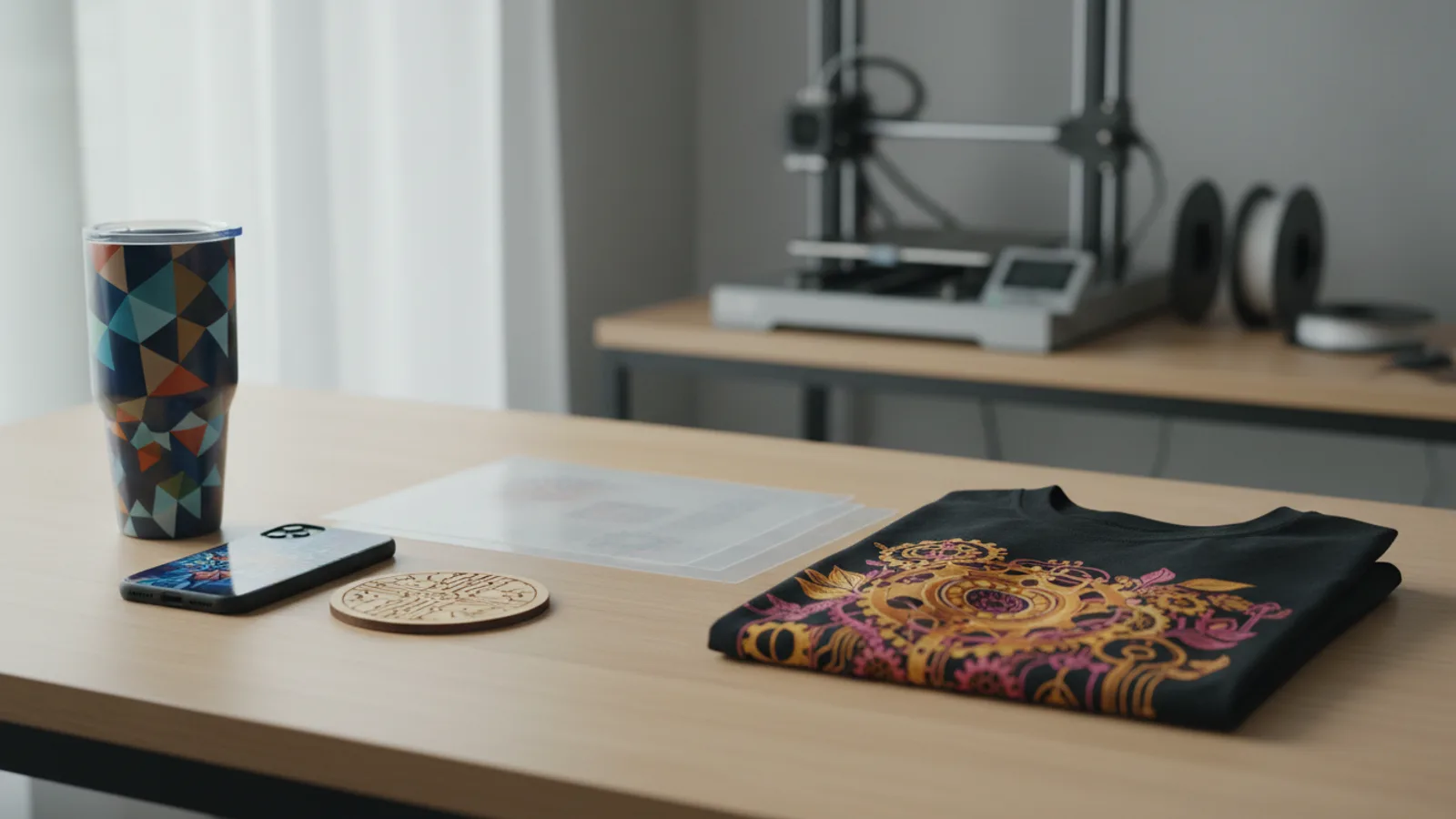
Walk around a craft fair and half the custom products you see were made with one of two machines. The full-color tumbler with a slight raised texture? Probably a UV printer. The vivid graphic on a black hoodie? Very likely DTF. They both print color, but they solve completely different problems.
UV printers: color straight onto hard stuff
A UV printer is an inkjet that uses UV-curable ink. The moment a droplet lands, UV LEDs on the print head harden it. Because the ink cures instantly instead of soaking in, it can print onto almost any rigid or semi-rigid surface.
What you can make:
- Tumblers, bottles and mugs (with a rotary attachment)
- Phone cases, acrylic signs, keychains and badges
- Wood, leather, metal, glass, stone and ceramic tiles
- Raised, textured prints by stacking layers of ink and varnish
How it works: most desktop UV printers lay down a white base layer, then CMYK color, then optional clear varnish for gloss or texture. You place the object in the machine, align the design (often with a camera) and print.
Good to know: UV ink sits on the surface, so it can scratch on items that get heavy handling, and it isn’t food-safe on areas that touch food or lips. Ink is the big running cost, and the printers want regular use so the heads don’t clog.
DTF printers: transfers for clothing
DTF stands for direct-to-film. Instead of printing on the garment, you print your design onto a clear PET film, then press it on with heat.
The process:
- Print the design in color, mirrored, onto film, with a white ink layer on top.
- While the ink is wet, cover it with a hot-melt adhesive powder and shake off the extra.
- Cure the powder with heat so it melts into a tacky layer.
- Heat-press the film onto the garment, then peel it away.
What you can make: t-shirts, hoodies, hats, tote bags, aprons and team uniforms, on cotton, polyester and blends, light or dark.
Good to know: you’ll need a heat press and a way to apply and cure the powder, so a full setup is more than the printer. The upside is that you can print hundreds of transfers ahead of time and press them on demand.
Side by side
| UV printer | DTF printer | |
|---|---|---|
| Prints onto | Hard and flat or round objects | Film, then pressed onto fabric |
| Best for | Drinkware, signs, cases, promo items | Apparel and soft goods |
| Extra gear | Rotary for cylinders | Heat press, powder, curing |
| Feel of print | Slightly raised, can be textured | Soft, flexible film on fabric |
| Biggest running cost | Ink | Ink, film and powder |
Which should you buy?
Get a UV printer if your products are things people hold and display: personalized tumblers, signs, phone cases, awards, wooden gifts. It also pairs nicely with a laser, because you can cut a shape and then print color onto it.
Get a DTF printer if you sell clothing. It handles dark fabrics, mixed fabrics and small runs better than most alternatives.
If you’re mostly making stickers and the odd shirt, neither might be right yet. A print-and-cut machine like xTool’s new C1 Color Cutter prints, scans and cuts, and its ink is rated for washing on fabric. And if you want to cut or engrave rather than print, our laser guide covers that side.
Quick answers
Can a UV printer print on t-shirts?
Not well. UV ink sits on top of the surface and cracks on soft fabric. For clothing, DTF or a print-and-cut machine with fabric-rated ink is the better tool.
Does DTF work on dark shirts?
Yes. DTF prints a white ink layer under the color, so designs stay bright on black and colored fabric.
What's the difference between DTF and DTG?
DTG (direct to garment) prints straight onto the shirt. DTF prints onto film first, then you heat-press the transfer onto the garment, which works on more fabric types and lets you print transfers in advance.
Do UV and DTF printers need ventilation?
Both use inks and, for DTF, an adhesive powder that's heated, so print in a ventilated space and follow the maker's guidance on fumes and handling.