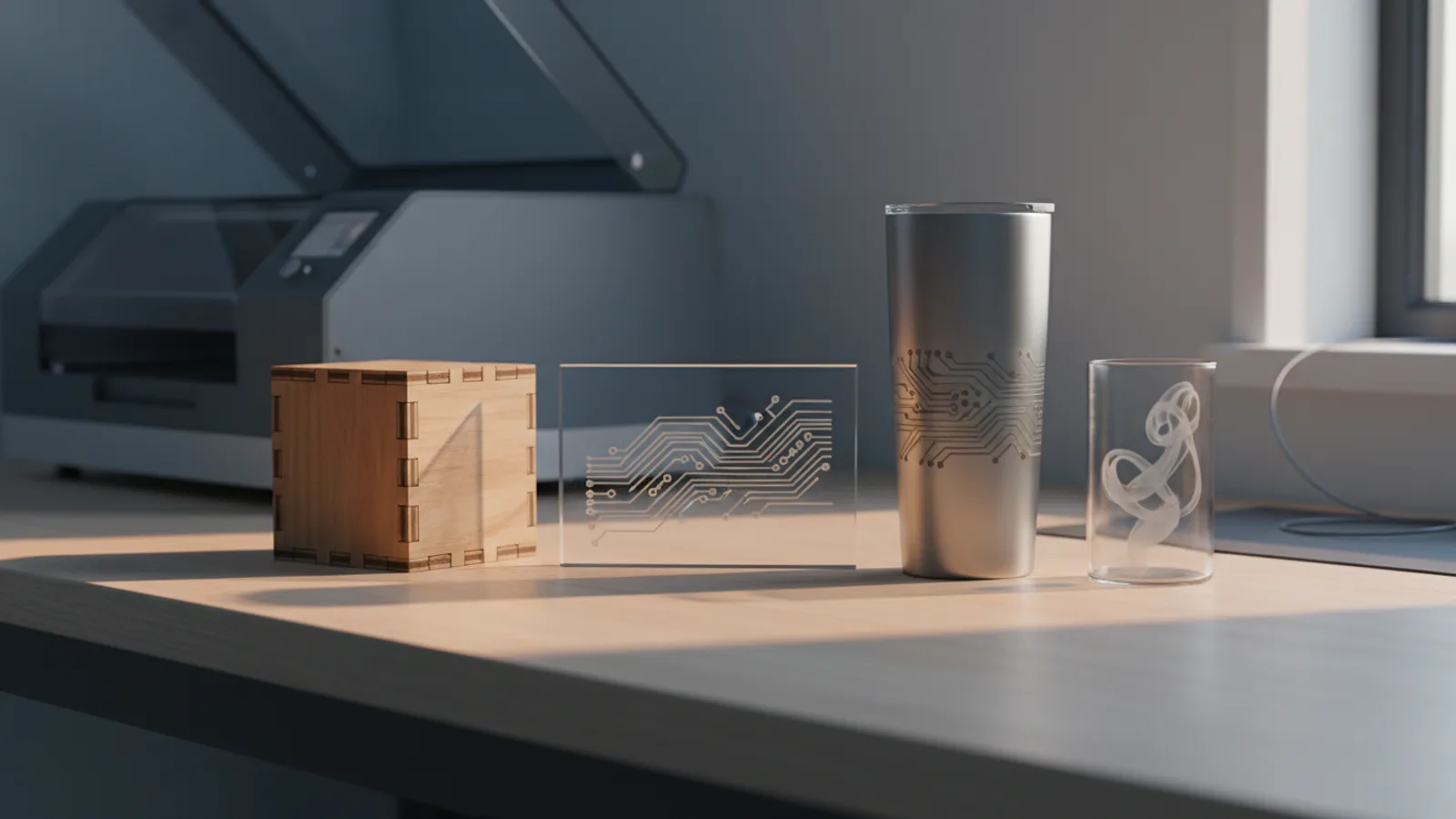
A laser engraver points a focused beam at a material and either burns away the surface (engraving), changes its color (marking), or goes all the way through (cutting). Simple enough. The confusing part is that “laser engraver” covers several very different machines, and the type of laser decides what it can and can’t touch.
Here’s the short version: the wavelength is everything. Each laser type emits light that some materials absorb and others ignore. Pick the laser that matches the materials you want to sell or make.
Diode lasers: the affordable starting point
Diode lasers are the most common entry machines. They use blue light (around 450 nm) from semiconductor diodes, and several diodes are often combined for more power.
- Good at: engraving and cutting wood, plywood, leather, cardboard, cork, dark acrylic and fabric. Engraving coated and anodized metal, and slate.
- Can’t do: clear acrylic (the blue light passes through), and it struggles with light-colored materials.
- Watch for: “laser power” vs “optical power”. The number that matters is optical output in watts, not the electrical input.
CO2 lasers: the cutting workhorse
CO2 lasers use a gas-filled tube that emits far-infrared light (10.6 µm). Almost all organic materials soak that up, which makes CO2 the go-to for cutting.
- Good at: cutting thick wood and plywood, clear and colored acrylic, leather, fabric, paper and rubber. Engraving glass, stone and coated metals.
- Can’t do: engrave bare metal on its own.
- Example: Bambu Lab’s 55W CO2 R1 is rated for 18 mm walnut plywood and 20 mm acrylic.
If you want to sell acrylic signs, keychains or cake toppers, you want CO2.
Fiber and MOPA lasers: made for metal
Fiber lasers emit near-infrared light (around 1,064 nm) that metal absorbs well. They’re almost always galvo machines built for marking rather than cutting.
- Good at: deep engraving and marking stainless steel, aluminum, brass, titanium and many hard plastics. Think tumblers, knives, tags and jewelry.
- MOPA is a fiber laser with adjustable pulse length, which lets it produce colors on stainless steel and cleaner marks on plastics and anodized aluminum.
- Can’t do: cut wood or acrylic in any useful way.
UV lasers: cold marking for delicate stuff
UV lasers (around 355 nm) mark with very little heat. That makes them ideal for glass, ceramics, white plastics, silicone and other materials that would melt, crack or yellow under a hotter beam. They’re low in power and not for cutting.
Gantry vs galvo
This is the other big split, and it’s about how the beam moves.
- Gantry: the laser head rides on rails across the bed, like a plotter. Slower, but covers a big area, so it’s what you use for cutting sheets.
- Galvo: the head stays put and two tiny mirrors flick the beam across the work. It’s dramatically faster for marking and engraving, but the field is small.
Some new machines do both. xTool’s X1 pairs a 55W CO2 gantry with a galvo head and lets you swap in fiber, MOPA or UV sources one at a time.
Quick picker
| You want to… | Get |
|---|---|
| Engrave wood and leather on a budget | Diode |
| Cut thick plywood or any clear acrylic | CO2 |
| Engrave tumblers, tags and knives | Fiber |
| Color-mark stainless steel | MOPA |
| Mark glass or delicate plastics | UV |
Safety, the non-negotiable part
- Eyes: open-frame lasers need safety glasses rated for that exact wavelength. An enclosed machine rated Class 1 is the safest option for a home, as long as the lid stays shut.
- Fumes: vent outside or use a proper filter. Wood and acrylic smoke isn’t something to breathe in a spare room.
- Never cut PVC or vinyl. It releases chlorine gas that harms you and corrodes the machine.
- Fire: never leave a cutting job running unattended, and keep an extinguisher nearby.
The software side matters too. Good nesting and camera alignment save more time than an extra 5 watts. See what xTool just added in Studio 1.10.
Quick answers
Can a diode laser cut acrylic?
It can cut dark, opaque acrylic, but not clear or most light-colored acrylic, because its blue light passes straight through. Clear acrylic needs a CO2 laser.
Can a CO2 laser engrave metal?
Not directly. It can mark coated metal or bare metal treated with a marking spray, but for engraving bare steel, aluminum or brass you want a fiber or MOPA laser.
What does galvo mean on a laser engraver?
A galvo laser steers the beam with two fast-moving mirrors instead of moving the whole head on a gantry. It's much faster for marking small areas but covers a smaller field.
Do laser engravers need ventilation?
Yes. Burning wood, leather and acrylic makes smoke and fumes, so vent outside or use a proper air purifier. Never cut PVC or vinyl, which releases chlorine gas.